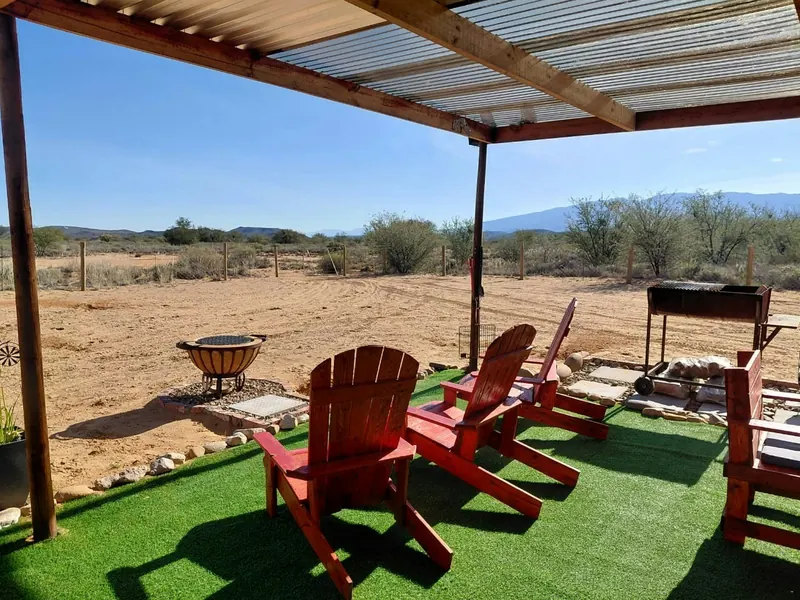
The farm keeps no game and feeds nothing, so everything on this list turns up on its own terms. Over a two-night stay most guests see several of them and nobody sees all of them.
What guests see most often
Gemsbok. Large, unmistakable, and the most impressive thing likely to cross your view. Usually at a distance across open ground, usually early.
Bushbuck. Smaller and much more secretive, favouring the thicker cover along the watercourse. Dawn and dusk.
Baboons. Troops move through the area and are heard as often as seen. Keep food inside and the caravan shut when you are not at it, and they are simply part of the soundtrack.
Scrub hares. Everywhere, once it is dark enough. A torch across the lawn will usually find a pair of eyes.
Mongoose. Quick, low and gone before you have the camera up. Daytime, near cover.
What turns up occasionally
Cape fox. Small, grey, with a bushy tail, and strictly nocturnal. These are the ones people hope for. Sitting still in the hot tub after dark is, genuinely, the best way anyone has found to see one.
Black-backed jackal. More often heard than seen. The call carries a long way across open veld at night and is one of the defining sounds of the Karoo.
Birds
The scrub and the watercourse hold the usual Karoo cast: korhaan calling across the flats at first light, bokmakierie duetting from the fence lines, sociable weavers and mousebirds around the yard, and raptors working the thermals through the middle of the day. Bring binoculars and you will fill a morning without leaving the chair.
How to actually see things
- Be out at the edges of the day. First light and the hour after sunset. The middle of a Karoo day is empty because everything sensible is lying down.
- Sit still. The most productive thing you can do here is stay in one chair for forty minutes.
- Use the water. Animals move towards the river. So should you, quietly.
- Go out after dark. Cape foxes, jackal and hares are all night animals, and the sky is worth the trip on its own.
- Keep the torch red or low. White light at full strength ends the encounter.
What is not here
No big cats, no elephant, no rhino, nothing that needs a guide or a vehicle. This is small, quiet, unmanaged Karoo wildlife seen from a chair on a farm, which is a different pleasure to a game drive and cheaper by an order of magnitude.